
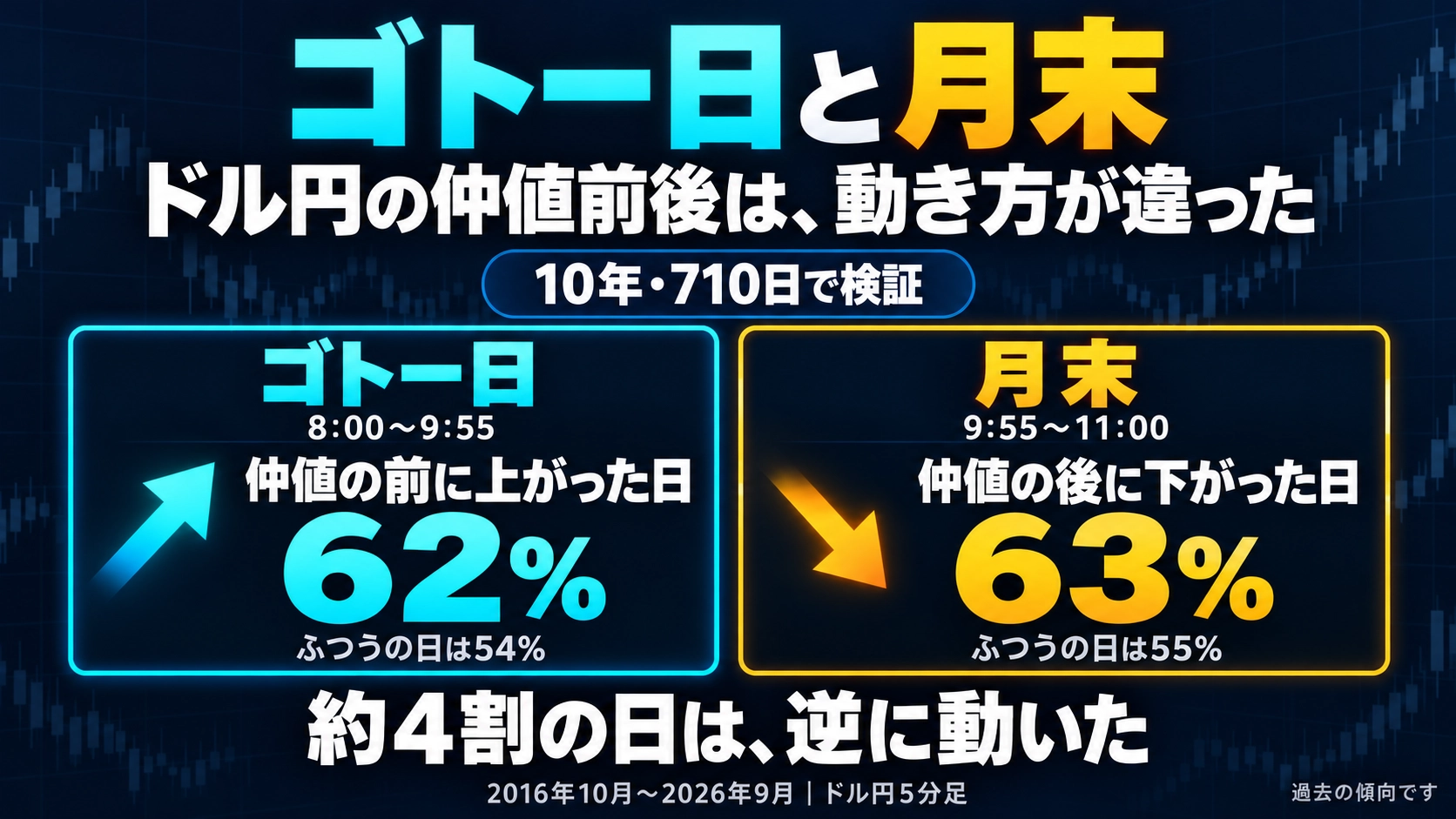
The Goto-day and month-end, around the midpoint of the dollar/yen, behaved differently|Counted over 10 years and 710 days
【New Product Introduction】
We released the MT5 indicator that notifies you on your smartphone when the price hits the level, “Omakase水平線 Pro” (the product I sell).
https://www.gogojungle.co.jp/tools/indicators/88552
There is a time in the USD/JPY when it moves best, every morning at9:55.
It is the time determined by banks for the day's exchange rate,the "Naka-ne" (level-rate)is called.
Gotō-bi (fifty-day)refers to days that end in5 and 10such as the 5th and 10th.
In Japan, payments between companies and settlement of prices tend to cluster on Gotō-bi and the end of the month.
Therefore in FX, it is often said that“Around Gotō-bi or the end of the month, the USD/JPY tends to rise toward the Naka-ne”.
Because importers buy dollars to pay overseas.
I checked whether this is really the case by counting ten years of USD/JPY data (October 2016 to September 2026).
Definitions used in this article
- Gotō-bi: 5, 10, 15, 20, 25
- End of month: the last business day of that month (such as 30th or 31st)
- If it falls on a weekend or holiday, it is shifted to the previous business day for both cases
- Before the Naka-ne:8:00–9:55After the Naka-ne:9:55–11:00
※ In dictionaries, Gotō-bi also includes the 30th, but in this article the 30th and 31st are categorized as “End of month.” Including the 30th as Gotō-bi gives almost the same results.
On Gotō-bi, “Before the Naka-ne” is different from “After the Naka-ne” at the end of the month
The dashed line represents ordinary days (not Gotō-bi or end of month).
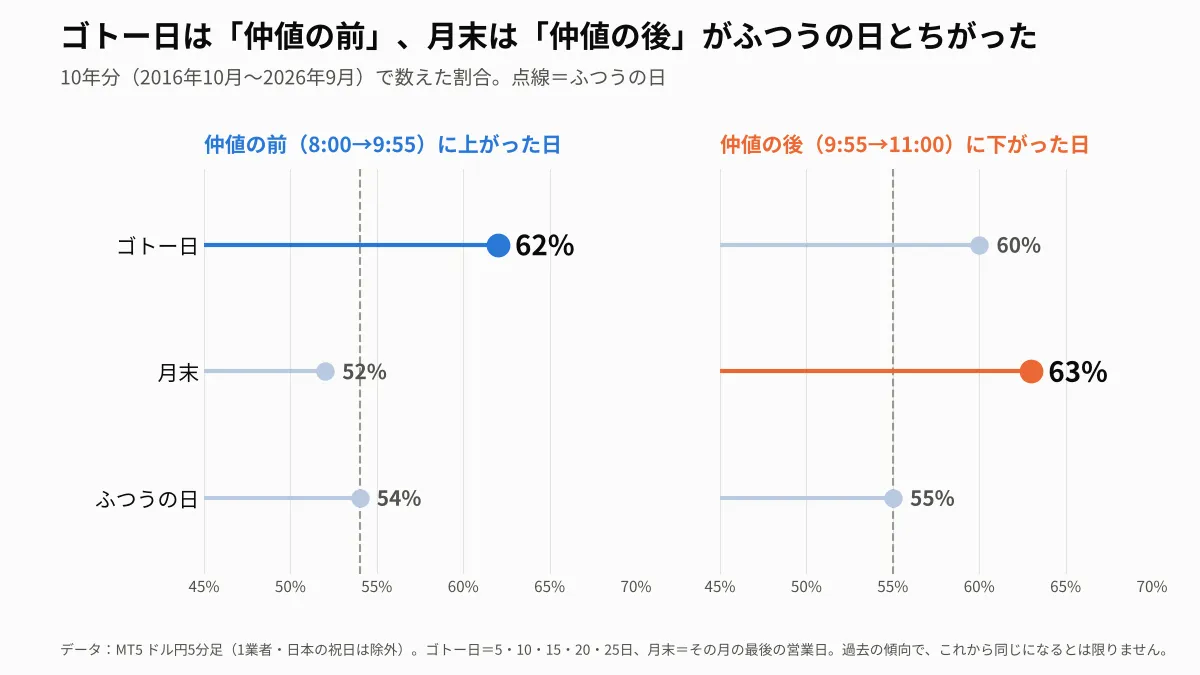
Gotō-bi: days that rose before the Naka-ne 62%
End of month: days that fell after the Naka-ne 63%
Ordinary days: days that rose before the Naka-ne 54%, and days that fell after the Naka-ne 55%.
Gotō-bi and end of month together are about8 percentage points more likelythan ordinary days.
On the other hand,the days that rose before the Naka-ne at the end of the month are 52% and almost the same as ordinary days.
The claim that “the dollar rises before the Naka-ne at the end of the month” could not be confirmed in this decade.
※ Even on ordinary days the rise is a bit more than half because the USD/JPY has risen from about 101 to about 158 in this decade.
I use this 9:55 a.m. time as a “FX Voice Reminder” to read my own text at a set time (a product I sell).
▶ See FX Voice Reminder (no install required)
When the Naka-ne moves significantly before and after, I also look at the prior high and low. The line is drawn automatically with the MT5 indicator “Omakase水平線” (the product I sell).