
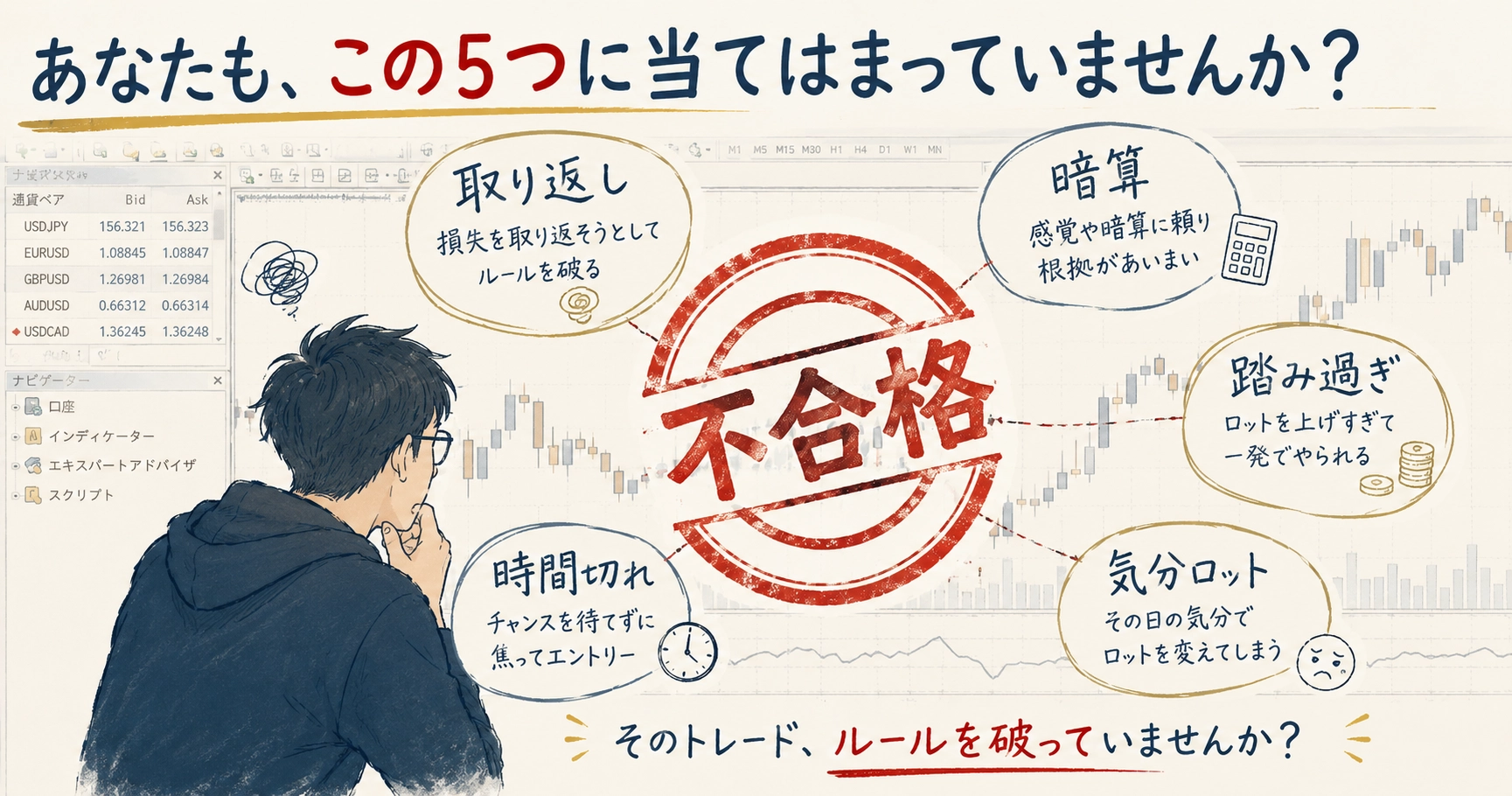
There were five common traits among traders who fall—verified patterns of prop failure revealed through validation
“The pass rate for prop firms is about 10–20%.”—a number you hear often. In other words,80% of those who attempt fail. I’ve failed many times myself and have eventually made it to the point of passing, so I understand the feelings and reasons of those who fall fairly well.
This article is a combination of my reflections after spending a long time on the “losing side” and what I learned from six months of data analysis.There are five surprisingly clear patterns among people who fail. If you know this first, your chances of avoiding the same mistakes will probably improve considerably.
Excuse me for the tangents,I am Lulu.fx. I am a current discretionary trader focusing on GOLD (XAUUSD), and I continue to build and test Expert Advisors on my own. I am now attempting to pass a prop firm (Company A), and I will share what I learned during that challenge in this article as well.
To jump to the conclusion first:The common point among those who fail isn’t “emotion” nor “method,” but at the deepest level it’s something you can’t see. At the end of this article, I will provide a physical solution to that “unseen” factor.
There were only five patterns for those who fail
Through investigating the causes of failures at prop firms and making my own mistakes, I found something surprising.The causes of failure seem countless, but they actually converge to five. No matter the technique, experience, or personality, in the end you’ll stumble on one of these five. If you keep this in mind from the start, you’ll reduce the odds of stepping on landmines dramatically.
First, the big picture
First, I’ll outline the five patterns. In the free section of this article, I’ll explain the essence of these five patterns as “what is happening,” and in the paid portion I’ll write about one common root cause and a physical way to solve it.
The five are, here.
Pattern ① “Recovery” and suddenly increasing the lot size
The most common pattern is this.After several losses in a row, you think “I want to erase all those losses with one big win,” so you put in a lot larger lot size than usual. I’ve done this many times. When calm, I would never touch that lot size, but in the moment my hand reaches for it.
The scary thing is that the person itself thinks, “This is a well-founded bet.” In fact, in their head they rationally reason, “If it reverses here, all the losses from this morning disappear and we’ll be back to green.”They are being driven by emotion without realizing it, which is the most troublesome part of this pattern.
When this one shot goes against you, the damage multiplies many times over your normal losses.Morning small losses were within the method’s expectations, but the three-times larger lot that you used to recover far exceeded expectations and caused huge losses. With prop trading, it’s common to break your daily loss limit with just this one move. The method itself isn’t at fault; the fault lies solely in your decision to change the lot size, which is the core of this pattern.
Pattern ② Managing the “daily loss limit” only in your head
Prop firms typically have“If you lose more than this in a day, you’re out” daily loss limit. If you touch this line, the challenge can end that day or entirely, which shows how crucial it is. Yet many people try to manage it just with“mental calculations”.
“I think I have about 20,000 yen left for today….”—that kind of thinking. In normal times you might still have some accuracy, but when losses mount and you’re anxious, this mental arithmetic becomes more and more optimistic. You end up hitting a line you shouldn’t cross.The emotion distorts judgment, and you end up relying on memory and mental math in the exact moment you need judgment the least.
Even simply writing down how much you have left today on a piece of paper and sticking it next to your screen can reduce accidents. Without doing that, relying on vague mental buffer leads you to cross the line somewhere, someday.
Pattern ③ “Overdoing the overall drawdown”
In addition to the daily cap,there is another line: “If you lose more than this overall across the challenge, you’re out”. The most common failure I observed during my testing was actually this pattern, the“overall drawdown line being gradually crossed”.
It doesn’t end with one day. One day −1%, the next −0.5%, then −1.5%… slowly you accumulate and suddenly you’re in the danger zone at −5%, −7%, etc.You end up finishing without realizing it by a sequence of “still okay” days, the quietest and most common way to fail.
What’s scary is that this gradual creeping is not noticeable in daily trading. Each day may seem a little off, but overall you’re near the end of the line with, for example, “only 3% left.” If you don’t have this sense of distance, a pattern ① or ② can push you over the line in an instant.
Pattern ④ Not conscious of a time limit
Depending on the plan, there is atime limit. If you’re on an unlimited plan, this may not apply, but for others, a low awareness of time can lead to crumbling in the late phase due to rushing.
If profits didn’t grow as planned early on, near the end you get the anxiety of “not making it in time.”Rushing to avoid time-out triggers the same behavior as Pattern ① (recovery). To avoid time-out, you raise the lot size; you increase illogical entries; as a result you accelerate Pattern ③’s gradual crossing, ending in exit.
The solution is actually simple:“When you choose a plan with a time limit, design the plan to win against time as well”. It’s too late to panic later. Choosing a plan that can realistically meet the target without overexertion from the start is actually a crucial choice.
Pattern ⑤ Changing the lot size every time based on mood
Last but not least is this.Your lot size for each trade changes day by day, or even by time of day. “Today I’m confident, so I’ll trade a bit larger,” or “I feel uneasy, so I’ll cut in half.”—with no consistent risk baseline.
Why is this deadly? Becausethe general rule becomes “small lots on winning trades, large lots on losing trades”. In confident moments you’ll have stable moves and small profit, in uncertain moments (when market conditions are rough and hard to read) you’ll have big moves, and you end up applying big lots there.The balance between win amount and loss amount deteriorates slowly.
This is the free portion of the article. From here on, I discuss“the one root cause common to these five patterns”,why willpower alone cannot solve these five patterns, andthe practical conclusion that if you want to pass, you should rely on tools rather than mindset, and what to visualize.
Continue here to see:
- What is the“one single root cause”shared by the five patterns
- Why“willpower alone cannot prevent these five patterns”, the brain mechanisms behind it
- What I arrived atthe “system that does not rely on emotion”for
- If you want to pass, you should abandon mindset andrely on tools, the reasons and what to visualize
- The “visualization rules” I personally useto show you exactly as I use them.