
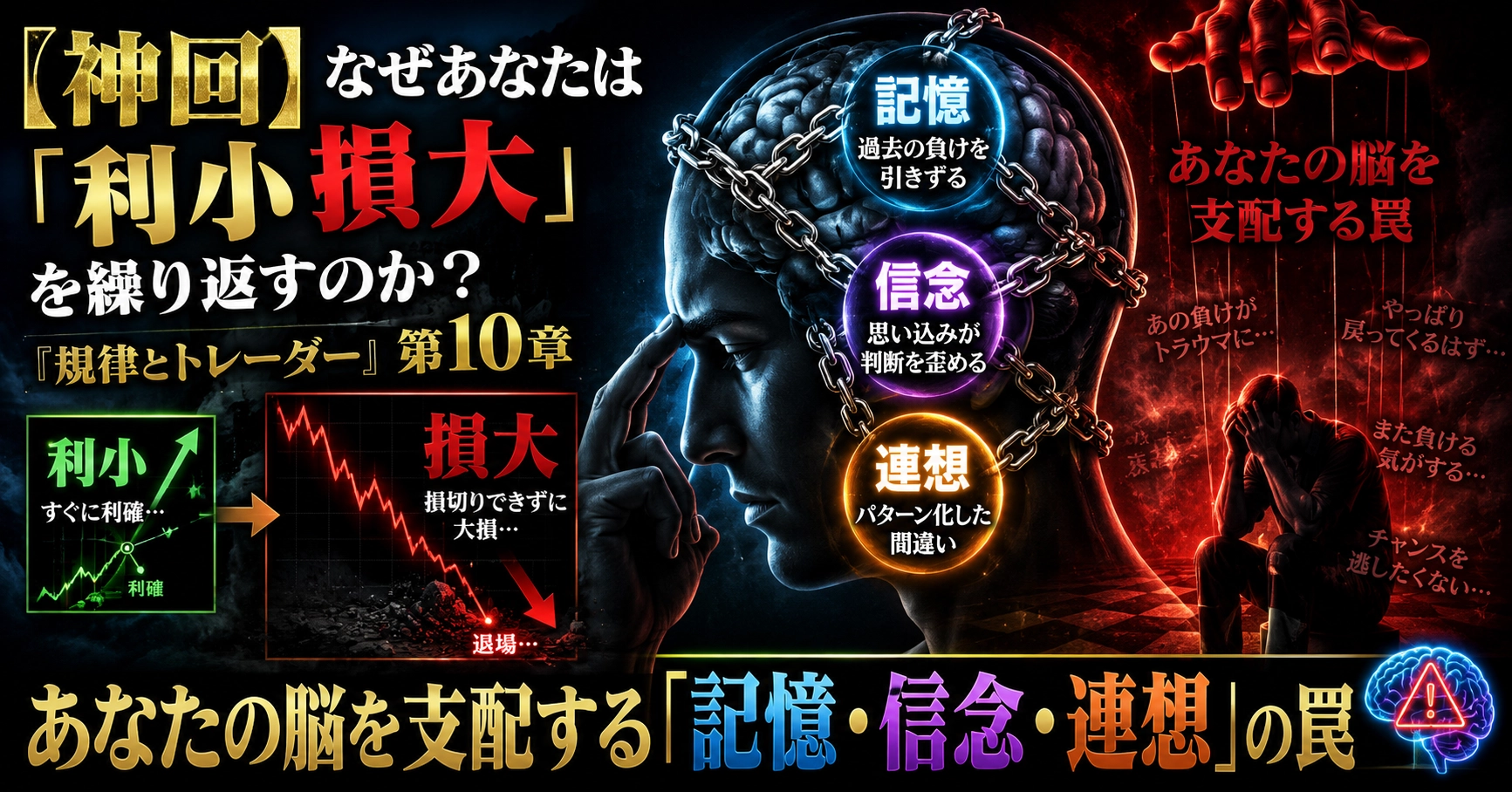
【Stopwatch Moment】Why do you repeatedly choose small gains and big losses? “Discipline and Traders” Chapter 10: The traps of your brain—“Memory, Belief, and Association” ??
To all readers: About this series ?✨
Hello! Thank you so much for reading as always?
This time, we bring you a deep-dive series that explains in the easiest possible way the classic work that traders around the world consider their Bible,“Discipline and the Trader: An Introduction to Market Psychology” by Mark Douglaswhich is loved as a Bible by winning traders worldwide, in a way that’s easier to understand than anywhere else!
This time we thoroughly explain【Chapter 10: How memory, beliefs, and associations control external information】in detail!
This book has truly wonderful content, but its psychological expressions and abstract terms can be quite difficult, and many may feel like “it’s honestly hard and I gave up halfway…?”
But don’t worry!?
In this article,we break it down super plainly so you can read it easily on your smartphoneand explain how to apply it in real trading!
From now onChapter 11 “Why do we need to learn how to adapt to the external world?”,Chapter 12 “The Dynamics of Goal Achievement”…we will delve deeper into the core of the book in continues installments, so please don’t miss it【Follow】 and 【Like ❤️】and support us! ✨
Introduction: Why, even when we’re looking at the same chart, do some people win and others lose? ??
Quick question, to you.
On the same day, the same currency pair, looking at the exact same 5-minute chart, why is there a trader who can grab massive profits without hesitating, and another who’s paralyzed by fear and misses the opportunity?
“The trader who can seize profits without hesitation here”and
“The trader who stops at the moment of fear and misses the chance”
— why does this happen?
“Because the method is different?”
“Because of differences in experience?”
No. Mark Douglas makes this clear:
“Even if the information emitted by the market (the external world) is the same, if the framework of your memory, beliefs, and associations inside your mind is different, the reality you perceive is completely different.”?⚡
In other words!
The reason you can’t win in the market isn’t that you lack methods or indicators, butthat your past memories and beliefs are making the current bonus market invisible to you!?
If you understand Chapter 10, the mental blocks (curses) on your brain will melt away, and the market will look incredibly clear to you!✨
Let’s quickly dig into what’s happening in our brains!?
Chapter 1: Do we really see the market as it is? The secret of the brain’s “closed circuit” ?⚡
First, I’ll share the core of Chapter 10.
We think we view the external world (the market) objectively, but in fact we never see it clearly at all.?♂️?
What we recognize is
“our own reality translated through our past memories and beliefs, filtered by our senses”
that’s what it is! ??
? Beliefs and the closed circuit of reality
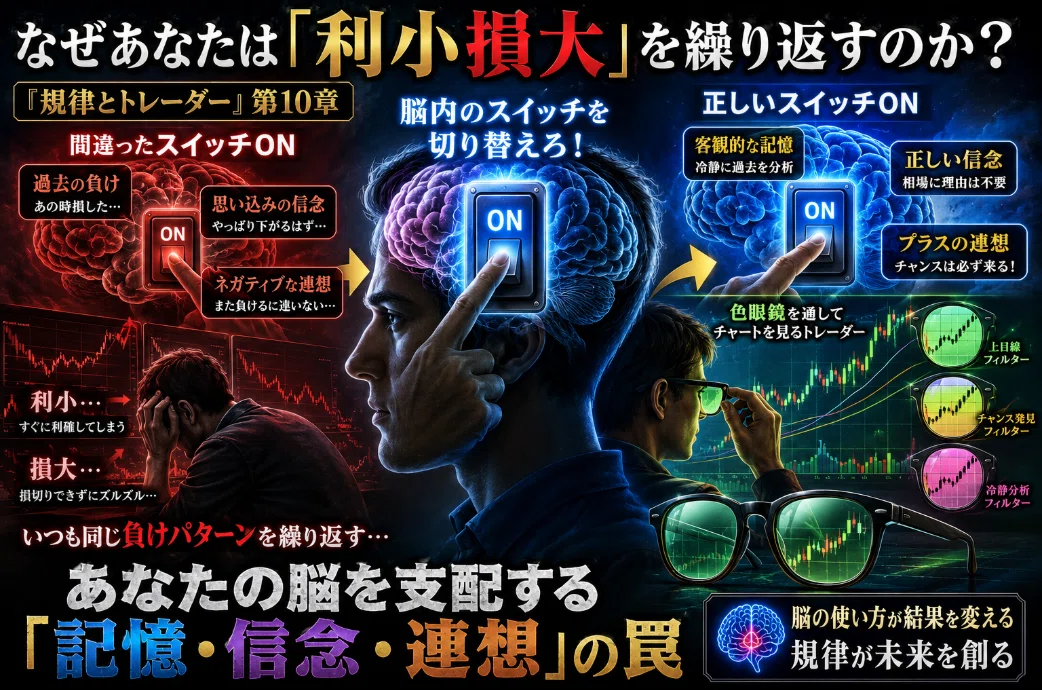
Douglas compares the relationship between our mind and the external world to“an electrical closed circuit (switch on/off)”
External world (the market) constantly emits infinite possibilities and signals ?
However, our brain“only when information matches our own beliefs does the switch turn on and the circuit closes (we can recognize it)”✅
Conversely,“information that contradicts our beliefs” or past painful information arrives, the switch stays open and the circuit is blocked (we don’t notice it) ❌
In other words, no matter how obvious a sure-win signal is in front of you, if your mind doesn’t have a framework to accept it,your brain will completely trash that information!?️?
Chapter 2: The shocking experiment! Why 90% ignore “just free money” ??️
Did you think, “If there’s a chance right in front of me, surely I’ll notice it?”
In the book, one of the most fascinating and striking episodes is the“Television experiment on Michigan Avenue”— we’ll share it here! ??
? 【Experiment details】
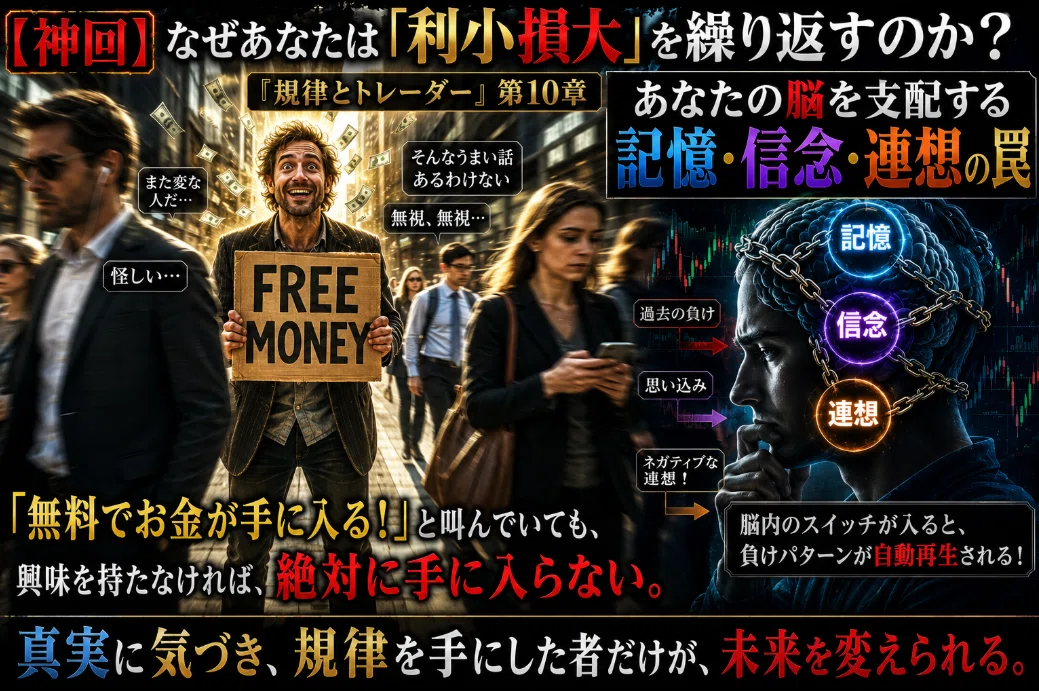
In 1987, a Chicago TV station conducted an interesting experiment on Michigan Avenue in the busy district.
A program staffer hung a sign reading“Free Money for Today Only!” and tried to hand out real cash to passersby for free!??
? 【What were people’s reactions…?】
If you think about it normally, you’d expect a crowd shouting, “Wow! Seriously?! Money!” right?
But the result wasshocking…
?♂️Most passersby completely ignored the sign and walked on!
?People avoided the man handing out money and left with puzzled looks!
One businessperson angrily said, “I don’t want money! Please don’t cling to me!”
Why did no one take the free money? ??
? 【Douglas explains the “truth”】
The reason is very simple.
Inside people’s minds, there was a strong fixed belief like “You can’t get free money from strangers on the street” and “there’s always a catch in a good deal.”??
Because their minds didn’t have a circuit for “getting free money,” even when genuine cash (a real bonus opportunity) was offered in front of them, the brain treated it as something unseen!??
⚠️ This is exactly what you’re doing in trading, right?
“I jumped in before on a breakout last time, so I’m scared this time too…?”
“This chart pattern is so perfect, but surely it will crash again… I’m doubtful.”
Thus, by using past negative memories and the belief that “the market is hard and you can’t win,”you may overlook the “bonus market (the same perfect opportunity as free money)” right in front of you!?Aren’t you missing out on opportunities because of that?! ??
Chapter 3: Fear narrows your view! The traps of “new driver” and “dog trauma” ??
So, why does our brain block such valuable information?
The biggest culprit is the fear from past trading“negative energy”!️
? ① The novice driver’s tiny field of vision
Imagine a new license holder driving on a narrow, busy road ??
Fear and anxiety of “What if I crash?” or “I don’t want to cause an accident!” makes you tense,and your field of vision becomes extremely narrow
When fear drains energy, external information essential to safe driving—signs, fellow passengers’ voices, pedestrians’ movements,—no longer enters the brain at all, and your vision narrows to a single point?❌
? ② A child bitten by a dog’s “false association”
Suppose a child was once bitten by a single vicious dog ??
In that child’s mind, a powerful negative association is built: “Dogs = dangerous, scary monsters.”
Then in the future, no matter how calm and well-trained the dog appears, the child will cry in fear and run away because of that fear?♂️?
Objectively it’s safe, but “past memories rewrite the present reality into something dangerous.”?⚠️
? What happens if we apply this to the market…?
When we’ve been hurt in the past by big losses or unable to cut losses, we end up in the same state as the novice driver or a dog-bit child.
The current chart offers a safe, high-probability bonus market (a cute dog) different from the past, but the brain paradoxically feels fear, narrows vision, and runs away from the opportunity! Such a waste…! ??

Chapter 4: Solving the eternal mystery! Why do ordinary traders become “small profits, big losses”? ⚖️ Bleeding
Now, here comes the climax of Chapter 10!
The tragedy almost all average traders fall into is
“Why, when there’s profit, do traders take small profits, and when there’s a loss, do they fail to cut and let losses run big?”
Douglas masterfully explains the true nature of this “small profits, big losses” illness by examining the direction of attention (the vector of fear) ??
? ① Why it becomes “small profits”
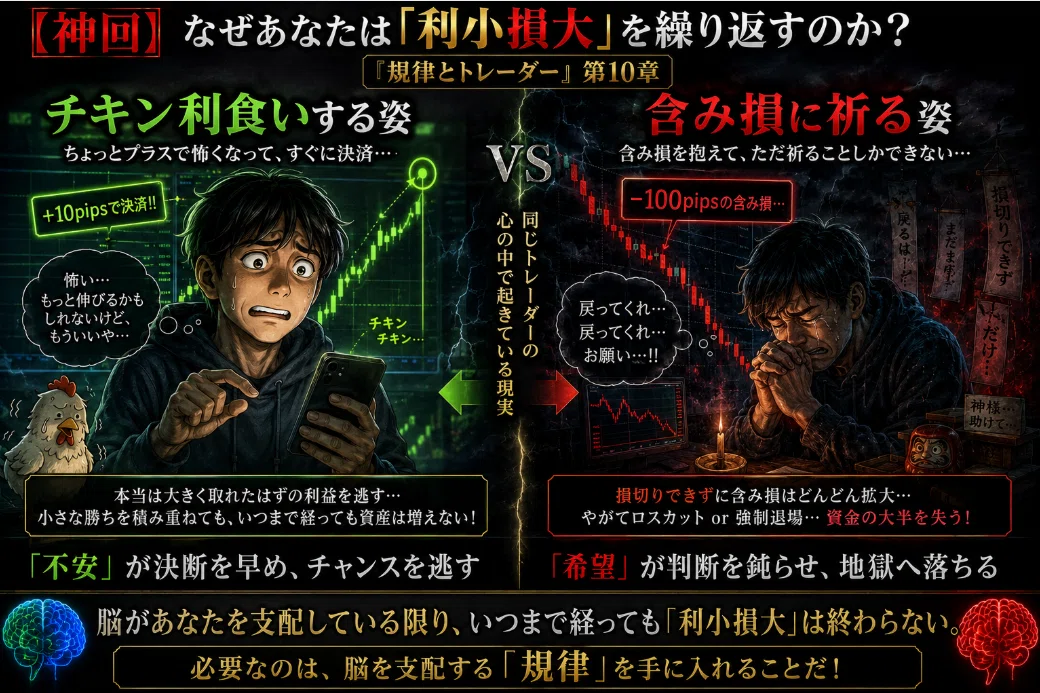
When there are unrealized gains, what dominates a trader’s mind is“I don’t want to lose the profits I’ve gained!”
Then the brain completely ignores signals that profits might keep growing and focuses intensely on information that the market might reverse and take the profit away!?⚠️
As a result, they can’t tolerate even a little anxiety and quickly relinquish positions with small profits!涙
? ② Why it becomes “unable to cut losses (big losses)”
Conversely, when a position moves against you and you’re holding unrealized losses, the trader’s mind is“I don’t want to admit I lost! I don’t want to lock in the loss!” fear. Fear!
Then the market moves further against you, and the brain blocks warning signals entirely (ignores them), clinging to convenient hopes and information that “perhaps the price will bounce back!”?祈
As a result, you can’t press the stop-loss button and extend the wound into a catastrophic loss (boom) until the account blows up! ?account burn
? Conclusion: We’re fighting not the market but our own fear!
You get it, right?
The reason for small profits and big losses isn’t low technique accuracy.
It’s because your brain is thrown around by the fear of losing profits and the fear of admitting mistakes, making objective market information invisible to you. Confidence?⚡
Chapter 5: Rewriting into a winning professional mind! “Self-trust” and “mind cleansing” ✨?
So, to break free from this chain of fear and the small-profit/big-loss curse,and evolve into a brains of a professional who can seize the current bonus market with ease—what exactly should we do? ?✨
Douglas’s answer is singular.
? Cleanse the mind and establish self-trust (confidence)!
To become a successful trader, you need a full “mind cleanse” that removes past loss-cut trauma and the fear of losing.?✨
Accept all information the market speaks with objectivity and maximize profits—this requires a rock-solid self-trust that you can control yourself no matter what! Shield?Specifically, practice the following three steps! ??
STEP 1: Notice your invisible filters (beliefs) ?️⚠️
“Oh, I’m about to chicken out and take tiny profits due to the fear of losing profits.” “I’m only looking for convenient information because I don’t want to cut losses.”Begin by stepping back and observing your brain’s habits (metacognition)—that’s where it all starts! ?✨
STEP 2: Take 100% responsibility for market results and fully accept risk ?️?
Before entering a trade, consciously accept what you could lose up to in this trade,enter with the fear at zero and with full acceptance of risk!
If you’re ready, your brain won’t sound alarms no matter which way the market moves, and you can read the chart objectively! Stay calm?♂️
STEP 3: Play the market with childlike natural curiosity ?
Even if the market doesn’t go as you wish, you don’t need to yell or get upset!
“Oh wow, the market moves like this now! It’s interesting!”Observe with a flexible, open curiosity like a child! Excited ✨
If you fill your mind with positive energy, your brain’s circuits will open, and you’ll clearly see the “free money” (big opportunities) that others miss! ?
Summary: Evolve your brain into a winner’s framework! ??
This time we thoroughly dissected Chapter 10 of “Discipline and the Trader”!
?We don’t see objective reality; we see only information filtered through our own belief’s closed circuit!
?When trapped by past trauma, you become the “new driver” and misperceive the big opportunities in front of you as dangerous dogs and miss them!
?The true nature of “small profits, big losses” is a brain bug caused by the fear of losing profits and the fear of admitting mistakes!
?By fully accepting risk and cultivating self-trust and curiosity, the market becomes your bonus stage!
What’s truly needed to win in the market isn’t chasing a new secret indicator but“updating the frame of your own mind”! ??
I hope this becomes a trigger for changing how you view charts from tomorrow onward, even a little! ✨
? Next Episode Preview & Request ?✨
Thank you so much for reading until the end! ??
Next time we’ll take the very important turning point in the book’s table of contents
【Chapter 11: Why do we need to learn how to adapt to the external world?】
to explain it more clearly and with even more passion!
We’ll delve into practical techniques on how to perfectly adjust ourselves to the uncooperative external world of the market and keep winning!?
“If you also want to read the next one! It was incredibly informative!”If you do,
【Follow】and stay tuned! ?✨
(Everyone’s “likes” and comments give this series the best energy to continue.)