

"Discipline and Traders" Introduction to Market Psychology Analysis Chapter 5 The Market Moves Continuously without a Beginning or an End ~The Reason Why People Who Cannot Become "Active Losers" Exit the Scene~
? Mark Douglas’s Complete Illustrated Series “Discipline and the Trader” is back with the long-awaited Chapter 5: The Market Moves Without a Beginning or an End, continuing to move!?
In Chapter 4, we learned about the danger of loading our dreams and hopes onto trading in an environment where profits and losses can be infinite—an eye-glass trap.
Now, in Chapter 5 that we will explain, we dive into the main reason why trading causes us the greatest psychological pain… the peculiar environment where the market has no “beginning” or “end”!??
Why do we rush to take profits when we are winning, and hold on to losing positions for too long when we are losing? How can we discard the market’s “revenge mindset”? We will reveal those brutal truths!
This series isa practical curriculum to elevate your mental state to pro level across 17 chapters (4 parts in total), with Chapter 6, Chapter 7… to come next.Please register as a favorite (bookmark) and install the lifelong “Discipline of Winners” with us! ?✨
?1. In a World Without a Bell: You Must Decide Everything
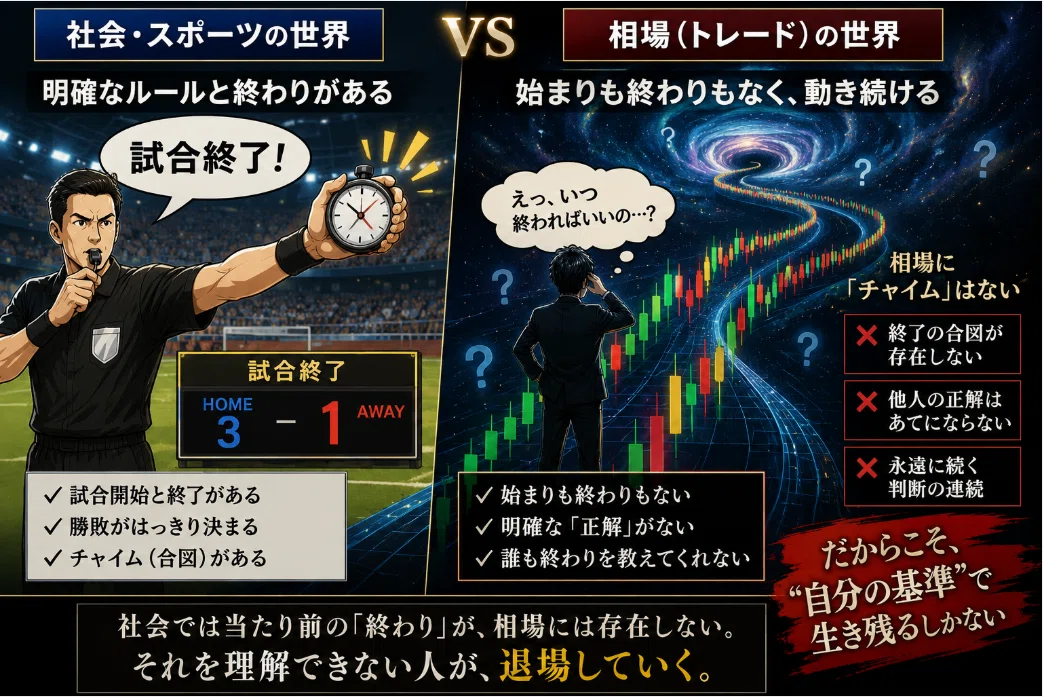
In the ordinary society we live in and in sports games, there is always a “signal of start (start bell)”and“signal of end (end chime).” The game time and rules are clearly determined by external factors.
However, what about the world of trading? The market moves at all times, may pause but never truly stops. No one yells “Game start!” and no one rings a bell telling you “Okay, today is the end—take profits!”
In other words, the market’s game requires you to decide everything —when to enter (start), when to take profits, and when to cut losses (end)—all at 100% freedom by yourself..
This “too perfect freedom” severely misleads a trader who lacks discipline.
?When winning:We worry it might go higher… but fear not taking profits due to an unsettled feeling, leading to a rushed take‑profit.
?When losing:There is no end signal, so we refuse to end the game by holding on, thinking it will come back someday.
⚡2. The Cruel Difference Between “Passive” Losers and “Active” Losers
Mark Douglas makes a sharp point about how losses are made in gambling versus trading.
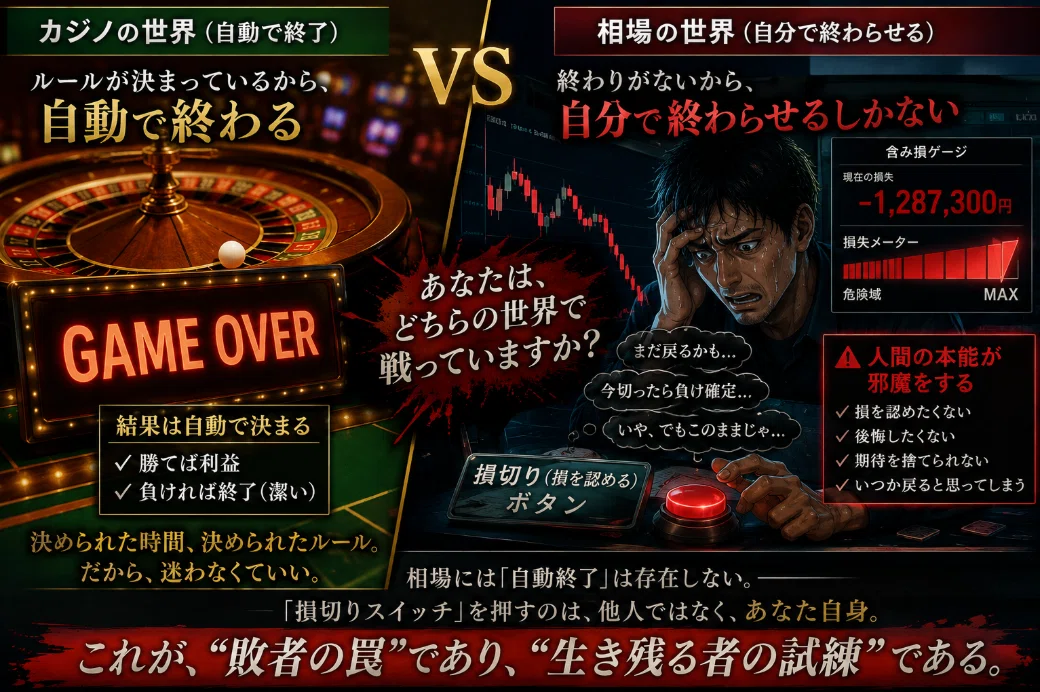
In casino blackjack or horse racing, when you lose you become a “passive loser” because after you place your bet, the rules automatically determine the outcome and end the game. You don’t need to take action to admit defeat, and you won’t lose more than your stake.
However, in the market you must become an “active loser”! In trading,you must actively decide to place a stop-loss order and close the position, or the loss game will never end!
Humans instinctively try to avoid the pain of admitting mistakes. Pressing the stop-loss button with your own hands—saying “I lost”—cuts into your mind like a sword. That is why nine out of ten traders refuse to be “active losers,” turn away from reality, enter “prayer mode,” and end up losing all their capital.
?3. I Want to Make Up My Last Loss! The Demon of Revenge Trading
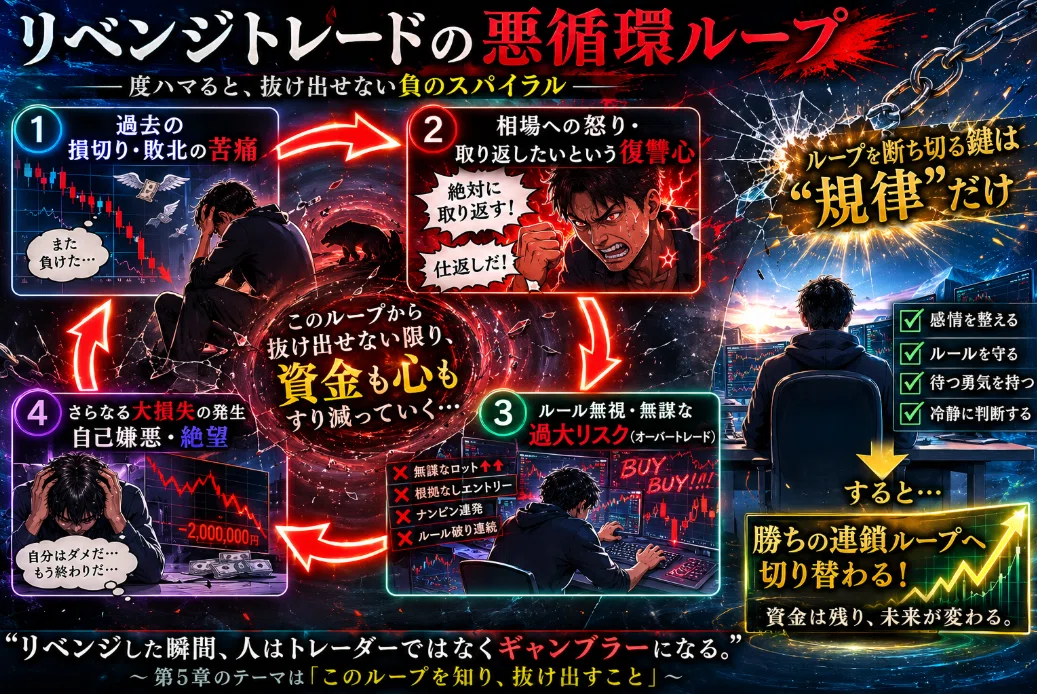
In an endless market environment, there is another terrifying trap that can ruin a trader: the revenge mindset toward the market (revenge trading).
For example, if you took a 5‑tick stop loss on your last trade. In the next trade you face a situation where objectively there is a wonderful 20‑tick profit. Normally you would take profits here and be highly successful.
However, your brain is filled with a revenge mindset of “I’ll get back what I lost last time! It’s not enough!” You strive to take back money the market took, ignoring objective profit signals and taking on more risk, and the market reverses, generating not only a profit but a new large loss.
Remember this.“How much you previously lost has nothing to do with the current market movement.”The moment you view the market as an enemy and bring personal grudges or revenge into it, we are eaten by the market—a gigantic monster.
?️4. A Prescription to Conquer a World Without Beginning or End
So how can one survive in this free, bell-less market world? The author’s winner’s mindset can be summarized in two points.
✅Be proud to “finish the game with your own hands” (be an active loser)Cutting losses is not bad or a defeat. Reframe your brain to see it as “a professional act to protect your capital by ending the game with your own decision.”
✅Fully isolate each trade (don’t drag past emotions)Whether you win or lose the last trade, the next trade is a completely new game. Let go of revenge toward the market and accept past damage to reset your mind, which is the only path to objective trading.
?【Next: Continuing to Chapter 6 and 7, a journey of mental evolution!】
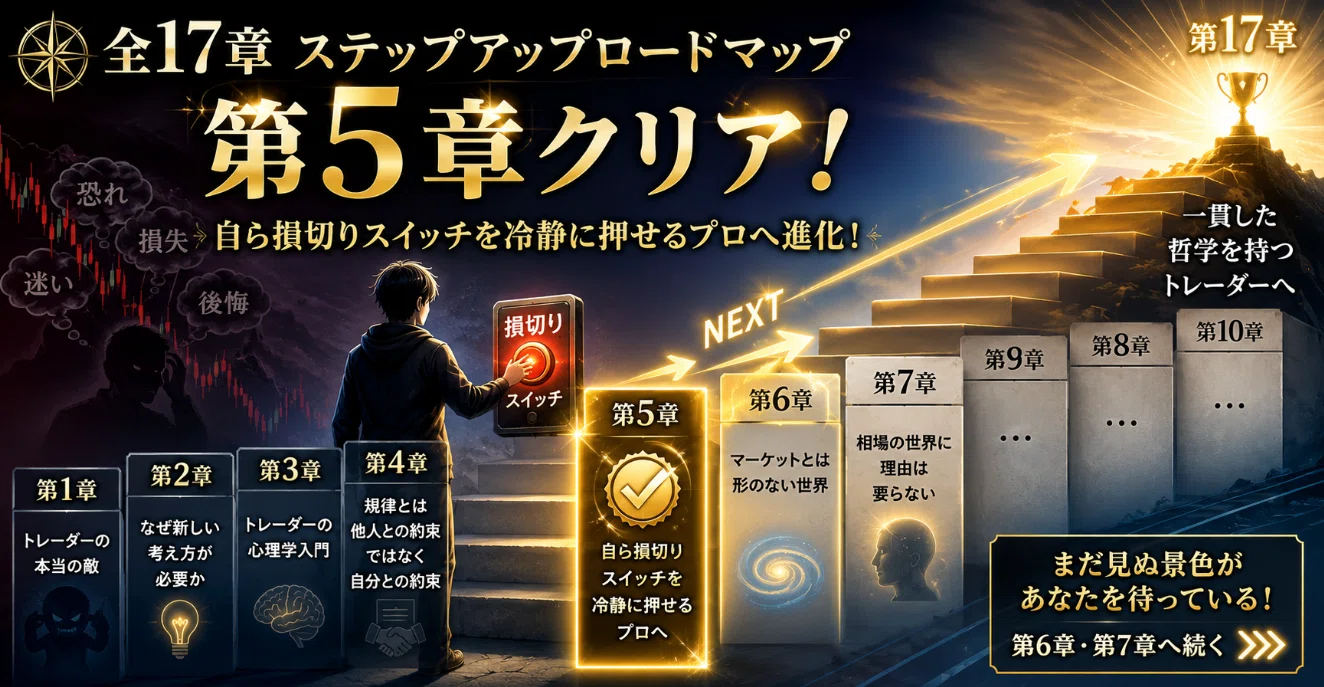
“Because the market has no end, you must have discipline to end the game yourself.” The lessons of Chapter 5 will drastically reduce unnecessary losses and chicken‑profit taking!
And the series will soon delve into the deeper essence of market environments and why we tend to make convenient interpretations!
?Next: Chapter 6: The Market Is a World Without FormIn social life, structures and rules keep us safe, but the market has no fixed structure or form. It is so free and formless. We will thoroughly dissect how to build an unwavering internal framework of discipline within your own mind!
?Beyond that: Chapter 7: The Market Needs No ReasonExplains how seeking “reasons or correct answers” for every market move—“Why did it go up now? Why did it go down?”—is a trap that wrecks your mental state.
Parts 3 and 4 continue to guide you toward an “undefeated pro mental state”In a journey through 17 chaptersIt continues! Please be sure not to miss the next update and check/follow now! ?✨
? 【Today's reflection work (tell us in the comments!)】
Thank you very much for reading to the end! To deeply engrave today’s lessons in your brain, please answer the following questions.
?“Have you ever felt the urge to revenge-trade after a past loss and taken a big hit? What excuses did you tell yourself in your mind at that time?”
Please vent your past sense of revenge in the comments—e.g., “I lost 50,000 just now, so I’ll double the lot next time to recoup it all!” Expressing past mistakes and viewing them objectively is the best way to maintain discipline in your next trade. ?✨