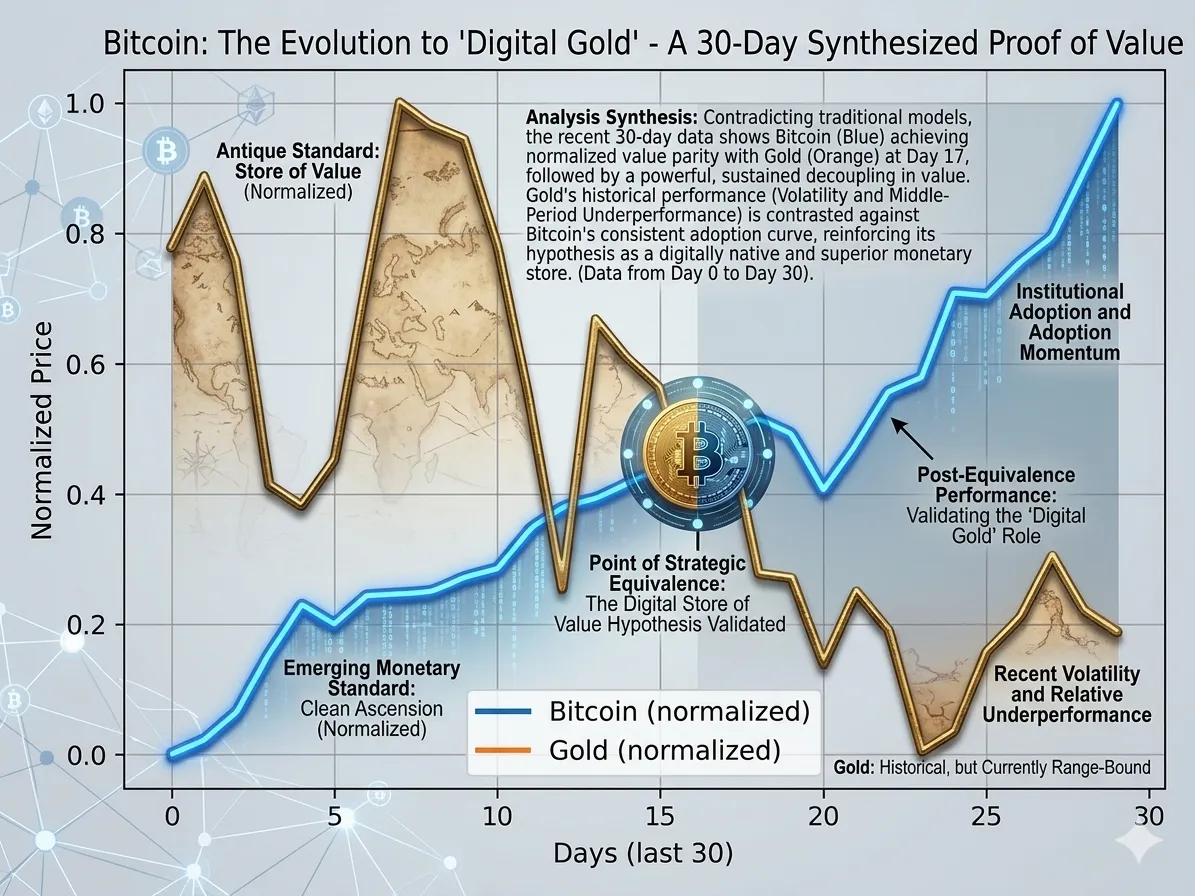

Today’s macro correlation [March 15, 2026] Is Bitcoin mutating? From "digital gold" to "operating system for capital movement"
March 2026.
With the arrival of spring, a “quiet rupture” runs through the financial markets.
For investors in the early 2020s, BTC was perceived as an alternative that possessed the same properties as gold, but offered higher volatility.
However, the scene we see today is overturning that premise from its very foundations.
Gold remains unmoved while Bitcoin jumps.
Geopolitical risk rises, yet gold loses its monopoly as a safe asset.
This phenomenon is not merely a short-term price divergence.
The map of macro correlations we know is being rewritten,in a historic moment when the “gravity of capital” has changed.
We will dissect the substance of this transformation.
Chapter 1: Burning Middle East, Silent Gold, and the “Dollar Cage”
1.1 Tensions in the Strait of Hormuz and the Energy Paradox
Currently, the Middle East situation has entered a phase far beyond the 2024 tensions. The United States–Israel alliance’s pressure on Iran has escalated to the brink of “military action” over nuclear development issues.
Under such circumstances, the usual first responders are oil and gold. Indeed, oil (WTI) has surged to the 110-dollar range per barrel. Yet a strange phenomenon is occurring here. Gold prices are “not moving.”
1.2 Why has gold ceased to be “safe”?
In 2026, the main reason gold is trapped in a range (1,950–2,100) is the completion of the “weaponization of the dollar.”.
The U.S. dollar now wields an unprecedented shield of “high yields and high liquidity.” In times of crisis, investors flock to the dollar (T-Bills) that yields more than 5% rather than “gold” that produces no interest.
Chapter 2: Looking into the Abyss of Credit Markets — The Bell of Credit Spreads
What investors should watch most is not flashy charts but the quietly expanding “credit spreads.”
2.1 The “eerie balance” of 3.17%
Current high-yield credit spreads stand at 3.17%.
This carries meaning beyond a mere number.
Let’s look at the following matrix.
| Level (%) | Meaning for Market Environment | Interpretation as of March 2026 |
| 2.5 or less | A blissful optimistic market | A relic of the past. |
| 3.0–3.5 | Red zone of caution | Current position. Investors are “pulling the trigger with their fingers.” |
| 4.0 or higher | Beginning of credit tightening | Corporates face real cash-flow problems. |
| 5.0 or higher | Repeat of a financial crisis | Explosive systemic risk. |
This 3.17% figure signals that the market recognizes something is about to break, yet maintains a stubborn bullish balance. Why has spreads widened so much while stock prices do not crash?
2.2 The “dual structure” of liquidity
The answer lies in liquidity’s dual structure. Traditional bank lending tightens (credit crunch), while private credit (unlisted bond markets) still holds enormous capital. This “invisible cash” prevents an outright surface collapse.
Chapter 3: VIX Speaks of Everyday Fear
The stock market fear gauge VIX has fallen from 35 in early March to 27. However, treating this as a sign of reassurance would be premature.
In 2026, investors are beginning to accept volatility itself as part of the asset class.
As VIX staying above 20 for more than half a year, the market has lost the stamina for panic and instead has developed resilience to trade amid high volatility. Is this maturity of the market, or a numb consequence? The next crash will tell.
Chapter 4: The Metamorphosis of Bitcoin — From Digital Gold to an OS for Capital Movement
Now, to the core of this article: Bitcoin.
There are three structural changes behind Bitcoin’s return to the 70,000s.
4.1 Michael Saylor and the “Reflective Loop”
MicroStrategy’s holding surpassing 700,000 BTC (about 3.3% of the supply) decisively changed Bitcoin’s nature.
The cycle they employ—“equity issuance” → BTC purchase—acts as a form of capital alchemy.
Issue their own stock at a high price.
With those funds, buy up scarce BTC.
If BTC price rises, their balance sheet strengthens and stock price climbs further.
Against the higher stock price, issue even larger amounts of equity.
This loop is no longer investment. It is an invention of a new corporate form using the Bitcoin protocol. As a result, BTC now has its own gravity detached from macroeconomic waves.
4.2 True Value as a “Capital Movement Asset”
As geopolitical risk rises, the wealthy and institutions realize a physical constraint: “Gold has difficulty crossing borders.”
Carrying tens of billions of dollars of gold out of war zones is nearly impossible, but with BTC, a single private key can move it instantly.
In 2026, the reason for the decoupling of BTC and GOLD is that gold represents “stagnant wealth,” while BTC is clearly “moving wealth.” .
Chapter 5: [Special Analysis] A Mathematical Look at Correlations
Here, let’s introduce a slightly technical viewpoint.
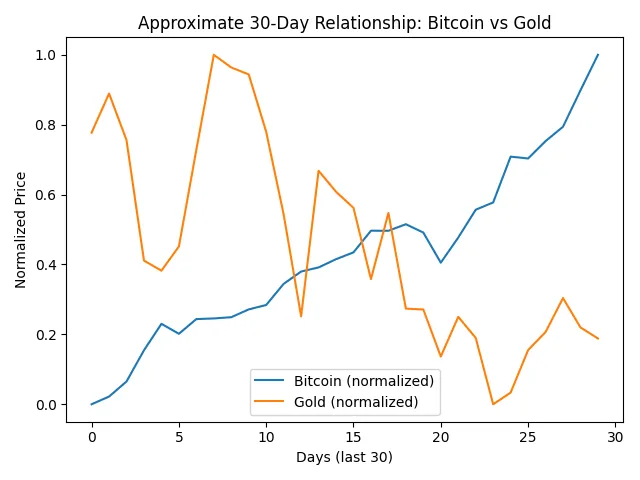
Where once BTC–GOLD correlation exceeded 0.5, it has fallen to around 0.15 now.
As shown, BTC has outperformed GOLD in the past 30 days.
Chapter 6: The Path of the Stock Market — Rebound or Cliff Edge
The current stock market looks like it’s dancing on thin ice.
Bullish catalysts:Realization of productivity gains from the AI revolution, abundant dry powder, ongoing buybacks.
Bearish catalysts:Cost-push inflation from high oil, persistently high long-term rates, widening credit spreads.
In the short term, a bear trap (a rapid rise to trap bears) is likely. Behind it, the淘汰 of low-quality companies has begun. In 2026, stock investing returns to a regime where selecting financially solid cash-flow generators, rather than simply buying indices, is key.
Chapter 7: Future Scenarios — Three Critical Points for Investors to Watch
How long can we stay in this “strange stability”? Here are three scenarios for the latter half of 2026. This is the author’s opinion and not guaranteed to be precise.
Scenario A: Liquidity-driven rally continues (probability 40%)
Oil stays below 90 dollars, credit spreads compress to 3.0% or less. In this case, BTC targets $100k, and the Nasdaq keeps making new highs.
Scenario B: Stagflation shock (probability 40%)
Oil breaks through $100, VIX exceeds 35. Gold is temporarily bid, but gains are limited by a stronger dollar. Meanwhile, BTC, as a means of movement, reaches a bottom earlier than equities.
Scenario C: Systemic credit event (probability 20%)
A large default in the high-yield market causes spreads to break above 4.5%. This becomes the “Lehman Brothers moment of 2026,” with all assets momentarily dumped in a “Cash is King” phase.
Philosophy demanded of investors in 2026
What the market on March 15, 2026 teaches us is a strong message: discard old textbooks.
Gold and Bitcoin begin to diverge, geopolitical risk blends into daily life, and corporations act like central banks. The weapon to survive in this chaotic world is not the comforting diversification of portfolios, but a correct understanding of the roles (functions) of assets.
Gold:A store of value. Yet it offers no return—an anchor.
Dollar:The strongest liquidity.
Bitcoin:A call option on the financial OS of the future.
Calling Bitcoin “digital gold” may already be outdated. It may be as undervalued as calling the Internet a “digital newspaper.”
We are witnessing the dawn of a new capitalism.