|
Hello! This is Li from GogoJoon.
Our highly popular content, a dialogue series between our company representative Hayakawa and developers!
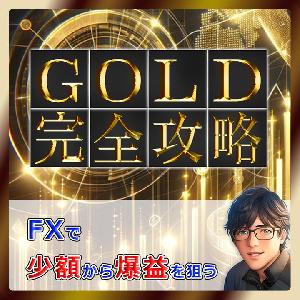
In this special interview, we are joined by investor Masashi, who consistently ranks high in the GogoJungle rankings and has created many popular contents such as the “GOLD” and “Popular Psychology” series.MasashiWe will ask Masashi-sama, who has a wide range of experience in stocks, FX, and gold, about his turning point and secrets to success.
Please enjoy until the end!
|
|
|
| After learning from over 500 books, building a unique theory |
|
Masashi
I am in my 16th year of investing. Currently I work part-time (self-employed and trading). I mainly trade GOLD. Since I discovered GOLD, my life really turned around, so I created a教材 that explains my approach in detail. If you’re interested, please take a look. I also plan to write an Investment Guide. Also, I love sweets, so please tell me good shops if you know any, haha. I am 172 cm tall and weigh 61 kg; I don’t eat extremely huge portions, but I hope to encounter an amazing sweetness.
|
|
| This is Hayakawa, president of GogoJoon! For today's guest Masashi, we have a free gift prepared for everyone who reads this article + watches the video. |
|

|
| GogoJoon Hayakawa |
|
|
Beginning of trading and turning points
|
| Masashi-sama, I heard you originally started with stock investing. When did you start and what prompted you to start? |
|
|
|
| GogoJoon Hayakawa |
|

|
| Masashi |
|
| I started investing around 2006. At that time the stock market was still doing well, just before the subprime mortgage crisis and the Lehman Brothers collapse. |
|
| I see, a period right before a major upheaval. After that, what motivated you to start FX? |
|
|
|
| GogoJoon Hayakawa |
|
|
|
| Masashi |
|
| Back then, my trading friends often chatted in chats, and many discussions suggested that FX is more efficient than stocks. At first I was skeptical, but once I tried it, I felt “this is amazing,” and naturally shifted to FX. |
|
| The experience cultivated in stock investing also benefited FX. FX was booming early on, but was it smooth from the start? |
|
|
|
| GogoJoon Hayakawa |
|
|
|
| Masashi |
|
| No, not at all. In the beginning I had ups and downs, wondering “can I really win?” I traded with small amounts while being cautious, so I couldn’t feel any significant gains. |
|
| How did you overcome that unstable period? |
|
|
|
| GogoJoon Hayakawa |
|
|
|
| Masashi |
|
| At one point I thought, “If I stay as I am, nothing will change,” and I boldly increased my lot size. At first it went well and I made profits, but then I kept going and suffered a big drawdown. Still, I think that was the turning point in how I approached trading. |
|
|
The Winning Flow Seen After Trial and Error
|
| How did you become consistently winning from there? Where was the turning point? |
|
|
|
| GogoJoon Hayakawa |
|
|
|
| Masashi |
|
| By increasing the lot size, I naturally started analyzing more carefully. I began to select entries more strictly, reducing impulsive entries. Because the lot size was larger, each decision carried more weight, which naturally increased my concentration. |
|
| 'Strict entry selection' is a striking phrase. Now, did you also change your mindset regarding exits? |
|
|
|
| GogoJoon Hayakawa |
|
|
|
| Masashi |
|
| Yes. I would look at short-term charts like the 1-minute chart and, from past patterns on the left side of the chart, assume “this could go that far,” but if I felt “this is no longer viable” I would exit early even if I had unrealized profits. The idea is to escape before losses become large. |
|
| I see, the key is to exit early even when it feels wasteful. |
|
|
|
| GogoJoon Hayakawa |
|
|
|
| Masashi |
|
| Yes. I look at the candlestick shapes and momentum, and if I determine that it’s too risky, I exit immediately. I draw lines from past charts to guide myself, but I prioritize “protecting” over “going for more.” |
|
| Whether entering or exiting, the keywords are “strict selection and calmness.” How about information gathering? |
|
|
|
| GogoJoon Hayakawa |
|
|
|
| Masashi |
|
| There were times I watched a lot of free information on YouTube and other places. But taking in too much at once confuses my brain and dulls my判断. So I kept only what I felt suited me and discarded the rest. |
|
|
The Culmination of Learning and a Simple Method
|
| You were also putting a lot of effort into technical analysis and study. How much did you study? |
|
|
|
| GogoJoon Hayakawa |
|
|
|
| Masashi |
|
| I think I read over 500 books. I tried many indicators, even created my own signals. I modified the contents and tested how they moved. |
|
| It’s fascinating that after such extensive study you ended up with just two moving averages. |
|
|
|
| GogoJoon Hayakawa |
|
|
|
| Masashi |
|
| That’s right. I learned that making things more complex leads to more confusion. Eventually I realized that only two moving averages are enough and work best for my trading. |
|
| Finally, you prepared an e-book as a special gift for this occasion. |
|
|
|
| GogoJoon Hayakawa |
|
|
|
| Masashi |
|
| Yes. It is a concise guide that summarizes three entry methods I actually use. It will be offered for about 1,000 yen, but I believe the content is worth much more. |
|
| This is a教材 condensed from real practitioners’ knowledge. I’m confident readers will find it very helpful. |
|
|
|
| GogoJoon Hayakawa |
|
|
|
| Masashi |
|
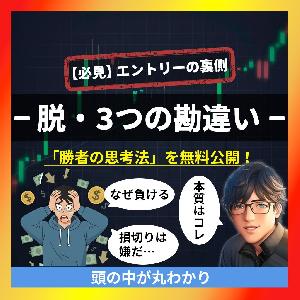
| For those who are unsure about trading, first review “how to enter” in three patterns. I believe this alone can change the results. |
|
|
Thank you for the valuable discussion today.
Next time, we will delve deeper into “GOLD Complete Strategy” and “Popular Psychology 1-minute Scalping.” Please look forward to it.
|
|
|
|
| GogoJoon Hayakawa |
|
| Episode 1 |
| Annual study and verification of 500 books—where we arrived: trading to win by escaping【Masashi/Ep.1】 |
|
|
|